On October 17, 2011, Toronto’s Auditor General, Jeff Griffiths, signed a report most residents never read. It was called “311 Toronto: Full Potential For Improving Customer Service Has Yet To Be Realized”, it went to the Audit Committee that November, and buried inside its twelve recommendations was the sentence that this whole story turns on. Recommendation 3 asked the city to “improve the service request status information such that customers are provided with accurate and clear status information on-line.”
Translated out of audit language: tell people what happened to the thing they reported.
The system underneath that sentence never had the layer it needed to make it true: a way to tell a resident what happened to the thing they reported, without the resident having to call and ask twice. What follows is what happened to that gap, era by era. Every date, document and quote below links out to the city’s own record or to the original news story, because the story is strong enough without embellishment and you should not have to take my word for any of it.
2011 to 2013: the promise gets written down, then stalls
City Council adopted the audit’s recommendations at its meeting on February 6, 2012. A year and a half later, the Auditor General went back to check what had been implemented. Nine of the twelve recommendations were fully implemented. Three were only partial, and Recommendation 3, the status-information one, was among them. Management’s answer, in the report’s own appendix, is one line: “Implementation is dependent on the timing of the new Work Management Systems currently in development.”
That sentence is honest in a way most city reports aren’t. The problem was never a lack of will. It was that the systems underneath 311, the actual software each city division used to track a pothole or a blocked drain, were older than the promise itself and stood in the way of keeping it.
If you called 311 in those years, you got a reference number and a sense that something had started. What happened after that lived inside a division’s own system, not in front of you.
2021 to 2023: the city starts saying the quiet part in public
On December 5, 2021, the one real-time, machine-readable way to check a request’s status from outside the city’s own systems, an interface called Open311, was retired. The monthly bulk file of service requests stayed live, and it is useful for researchers. It is no use at all to a resident checking on their own pothole. That is roughly when I went looking for a Canadian city with a 311 API you could file a report through, and stopped finding one.
But the pressure inside the building didn’t stop. In June 2022, Council adopted the 311 Toronto Annual Report on a motion from Councillor Shelley Carroll, carried 19 to 0 with six members absent, directing the City Manager to work with all divisions so that 311 is made aware of the conditions under which a resident’s service request ticket gets closed. In May 2023, Council asked staff to report back on shifting the whole model from a “customer” relationship toward “a more holistic approach that aims at resident engagement.” Small phrase, real signal: the city was noticing that a transaction and a relationship aren’t the same thing.
If you were the one filing the report in those years, none of that showed up on your end. The council motions were real, and you can read every meeting, every motion, every vote in plain language now. Your ticket still closed without a word, which is the silence I keep coming back to: the city fixes things and tells no one, so people stop reporting.
2024: the city says it out loud
On March 13, 2024, CBC reported what insiders had known for a while, under a headline that did not hedge: “Toronto’s complaint system is broken, say some.” The story put a number on it. Toronto’s 44 divisions each ran their own complaints process, some of them more than one, adding up to 49 unique systems. A pilot was going to try to pull all of that down to one.
Councillor Brad Bradford named the shape of it: “Divisional silos are a very real thing,” and residents “shouldn’t have to come to my office or another councillor’s office to get that taken care of.” Gary Yorke, then the city’s executive director of customer experience, was blunter about how it felt from outside: “It was very confusing from a public perspective.”
That is a city official agreeing, on the record, with the thing every resident who has ever called twice about the same pothole already knew.
2025: the plan gets a name and a budget line
On August 27, 2025, a staff report to the Service Excellence Committee, Efforts to Improve End-to-End Customer Experience, gave the fix a name: Closing the Loop, funded inside the 2025 to 2034 capital budget, alongside a second initiative to replace the legacy work management systems underneath it. The plan was staged, and the report is specific about it. Phase 1, in the fourth quarter of 2025, would bring service request notes and status updates. Phase 2, in the second quarter of 2026, would add “mandatory status information, picture sharing with customers, improved notifications.” The same report says the Customer Experience Division was “in the early stages of establishing a governance structure” to oversee the work. I had already written about this plan when it landed.
The same report is candid about why this took so long. The work management systems the divisions run on are, in its words, “now more than two decades old” and “operate independently from each other.” The systems were older than the promise, exactly as the 2013 follow-up said.
The city has also been shipping in the open. In October 2025 it launched a public Service Standard Dashboard, and the request-tracking page now lets you explore open requests in your neighbourhood without a reference number at all. Anyone who tells you the city has done nothing here has not looked.
The gap the audit named finally had a name of its own, a budget line, and a schedule for being built.
March 2026: I run the test
While that plan was still in its early stages, I filed the same pothole report three ways: through the app I’d built, through the city’s own online form, and by calling 311. Mine took about two minutes. The city’s form took about five. The phone call took about seven. TorontoToday and NOW Toronto both covered it that week, part of a run of coverage that also took in CBC Metro Morning and Global News. Neither story was about the stopwatch. Every reporter who called asked me the same question: why did I build it.
June 2026: the city confirms the plan is still ahead of us
On June 17, 2026, the city told CBC that its “closing the loop” features were coming “in the coming weeks.” Milestones would let someone know if their request had been inspected and if work was scheduled, and notes would help a requester understand why the outcome might differ from what they expected. The milestone feature would arrive first for the city’s most popular requests, potholes and sidewalk damage and tree pruning among them, and the full redesign of the portal used to submit requests continues into 2027.
The plan is real. It is also still a plan for most of what the city tracks.
July 2026: what closed looks like
The city publishes the status of every request it receives. I built the part that carries that status back to you, on the same public page where your report already lives. The city’s data, delivered on the resident’s timeline instead of the division’s. Nothing about this replaces 311 or the people answering it, and I am not claiming to have finished the city’s work for it. What I can say is narrower and, I think, harder to argue with: the thing Recommendation 3 described in 2011 is running today, in public, on every report that comes through my platform, and it got there ahead of the city’s own Phase 2 date.
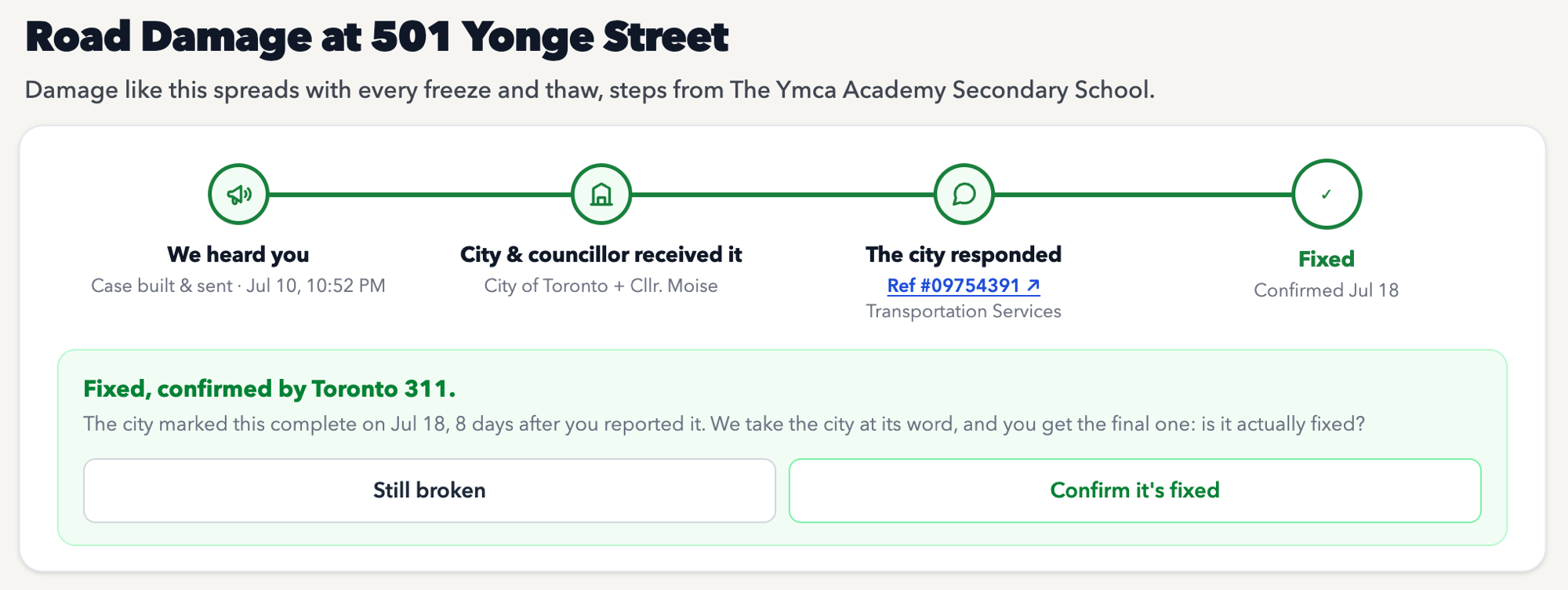
Here’s what that looks like for one real report. Someone photographed a stretch of damaged pavement at 501 Yonge Street at 10:52pm on a Friday night in July. The report reached the City of Toronto one minute later, at 10:53pm, and the ward councillor got the same case at the same time. Not long after, the city wrote back with a reference number, 09754391, and it went on the public page the same day it arrived, which is why every report on the platform carries one. From then on, the report was checked against the city’s own records to see if anything had changed. On day eight, the city marked the work complete, and the page flipped on its own. Nobody had to call back and ask. The green box that says “Fixed, confirmed by Toronto 311” was just there the next time the resident looked. That’s the feeling this whole thing is built around. Not a faster fix. The moment you find out someone was keeping watch the whole time.
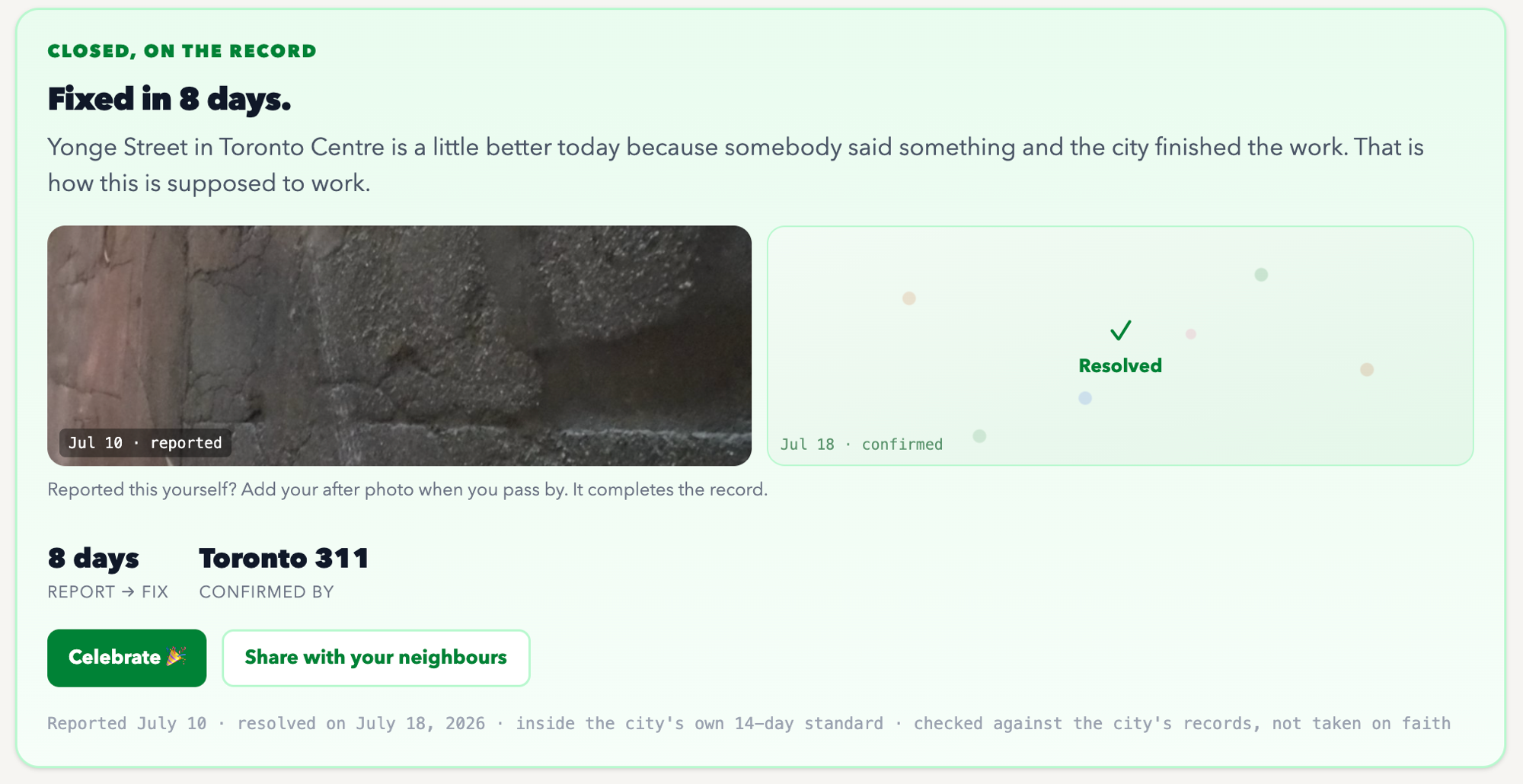 The same report, eight days later. Nobody called to ask.
Scroll that same report and you reach a section called the case we sent, and under it a short list of green check marks with real timestamps beside them. We heard you, and saw what you saw. We made sure no faces or licence plates travelled with your photo. We wrote the formal report in the city’s own language, for you. We found your ward and put your councillor on the record, for you. We delivered it to the city the same minute. We caught the city’s reference number so you never have to chase it. And when the city marked it fixed, we brought the answer back to you.
That last line is the one this entire timeline was waiting on, and it sits there on the page with a date next to it.
The system never had that feedback layer. Now it does, in Toronto. Since February 17, 2026, nearly a thousand reports have gone through the platform, and they have been coming back carrying a status the city itself confirmed as complete, checked against the city’s own records rather than taken on faith.
None of this is finished, and I’d rather say so than let you find out later. It works this way in Toronto today, and not yet in the other six cities on the platform. And it isn’t blind trust in whatever the city says either, because I have already written about what “completed” hides when a division closes a ticket by handing it to someone else. One report here came back marked complete, and the resident who filed it said no, it isn’t, and reopened it with a reason. That’s not a crack in the system. That’s the resident having the final word over the city’s own status, which was the point of putting your answer on the page next to the city’s in the first place. One reopen against weeks of confirmed completions is either a small number or a working safeguard, and I think it’s the second one.
What this was ever about
Underneath all the dates, the thing I built is not a faster way to report a pothole. Two minutes against five was never going to change anyone’s life. What changes is that you stop shouting into a building.
The old way charged you something that never showed up on any budget line. You reported the broken thing, and then nothing came back, and the silence taught you a lesson you didn’t ask to learn: that saying something doesn’t matter, that the street is just the way it is, that somebody else will deal with it or nobody will. People didn’t stop reporting because they stopped caring about where they live. They stopped because no one ever came back to tell them it worked.
So the green box is carrying more than a status. It is evidence, on your street, with your report attached to it, that what you did at 10:52 on a Friday night reached a real person and changed something eight days later. Your neighbour can open it. Your councillor is already on it. You never had to call and ask twice, because somebody was keeping watch on your behalf the whole time, and that is the part you never had before and could not have bought.
None of this had to fight the city to get here. It just had to finish the sentence Recommendation 3 started in 2011.