In January I was driving home on Don Mills Road, past the same pothole I had been swerving around for six or eight months, and I did what I always do when something breaks and nobody fixes it. I opened my laptop that night and started building. First commit, January 14th. Not a plan, not a deck, just code, because the fastest way I know how to argue with a broken system is to build the thing that fixes it. Within three hours it worked.
On February 17th the first report went out through it. One pothole, one city, one resident who was tired of waiting.
That could have stayed a personal project. A lot of things I build do. What changed it was a video I posted in March, a pothole reported two ways side by side: my app in three taps and thirty seconds, the City of Toronto’s form in five pages and twenty-some fields. That video has been watched more than 119,000 times and is still climbing. Within 48 hours I had done five interviews, TorontoToday, NOW Toronto, CBC Metro Morning among them, and every reporter asked me the same thing. Not how it worked. Why I built it.
That is the question that has followed this project ever since, and it is the one worth answering here.
Why a company, and not a hobby
A resident deciding whether to trust a reporting tool with their name and their street address is making a bet on whether it will still be there next year. A city councillor deciding whether to point constituents at it is making the same bet, at higher stakes, because their name is attached to the recommendation. A business improvement area deciding whether to run its own reporting through it is making the same bet again, with even more on the line.
Nobody makes that bet on a side project. I could keep calling this my pothole app and it would still work exactly as well as it does today, but nobody with something real to protect would build on top of it, and that includes me. A city is not going to route resident reports through something one person maintains between other things. It has to be something built to last, with a name on the door and a company behind the name, because permanence is not a nice-to-have for civic infrastructure. It is the whole point.
So this month the company got a name. Solve Canada, incorporated in May and named this month, is the company behind the platform, and it exists because the six cities running on it, and the residents and councillors and businesses trusting it, needed to see something more durable than one developer’s late nights. The pothole is still real. The company is what makes the fix stick.
Six cities, one front door each
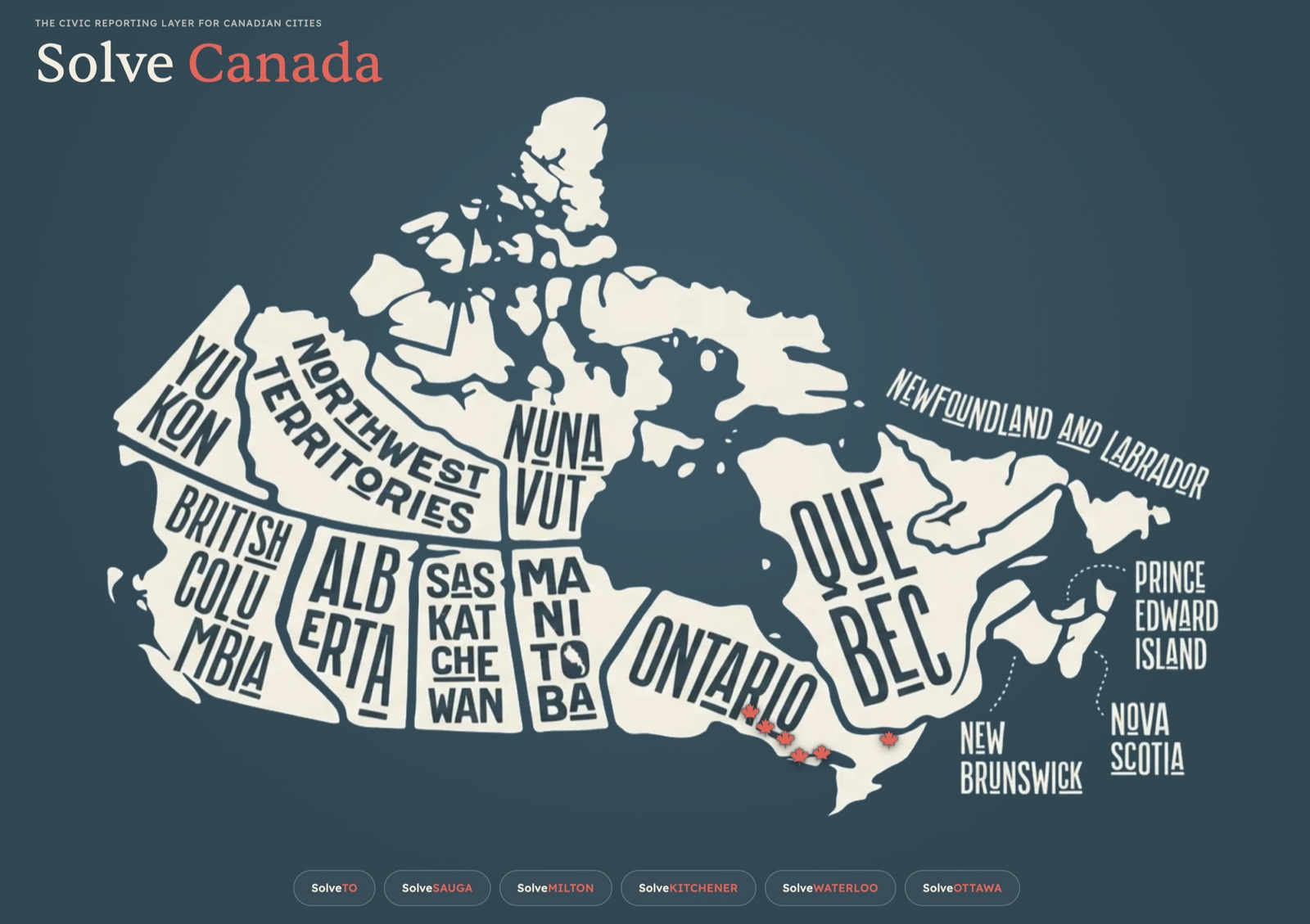
Here is what Solve Canada carries today. Toronto runs on it as SolveTO. Mississauga runs on it as SolveSAUGA. Milton, Kitchener, Waterloo, and Ottawa each run on it under their own name, their own map, their own councillors, all reachable at solvecanada.ca. Every city keeps the name its residents already recognize, because nobody in Kitchener wants to log into something called Toronto, and nobody should have to.
What they share is underneath, where it belongs. One account works in every city on the platform. One login carries your report history with you if you move, or if your life spans more than one place. The platform now carries more than 2 million pieces of public infrastructure across those six cities, hundreds of residents have an account, and hundreds of reports have moved from a phone in someone’s hand to a desk at a city since February. That is not a complaint box, it is civic intelligence: what residents report, sitting on top of the city’s own open data, so a resident, a councillor, and a business are all reading the same city from the same map.
The front door was always the easy part
Every city we have added kept its own name, its own map, its own council, because the front door is not the hard part and was never supposed to be the point of pride. The hard part was building something underneath that a sixth city could stand on without anyone having to start over. That part is done, and it is the reason a resident who moves from one of these cities to another does not have to relearn a single thing about how to be heard.
You can see it in how fast it moves now. Kitchener and Waterloo went live in a single afternoon. Ottawa took forty minutes. The next city will take less than thirty, because the platform underneath already knows how to carry one more.
A pothole was where this started, not where it stops. Every report and every piece of city data builds a living record of how a place actually works, and a record like that begins to matter to people who never file a report. The builder deciding where to dig. The insurer pricing a block. The campus or the hospital planning around what is actually on the ground. I am not going to spell out where that goes. The pothole was never the ceiling.
A company is what makes sure the next one, in whichever city it shows up, gets the same thirty seconds and the same follow-through that the first one did. That is solvecanada.ca.