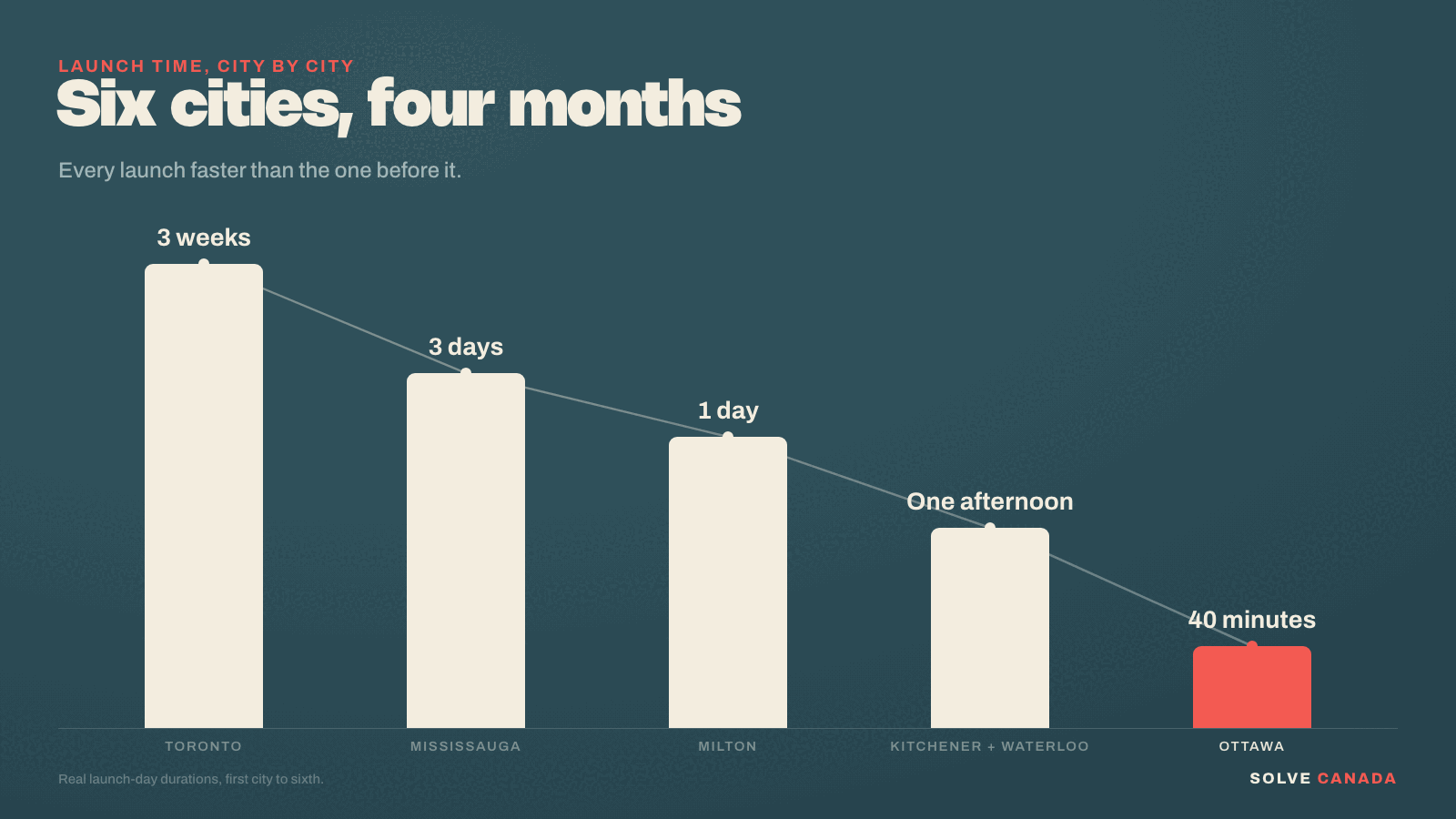
Toronto took 3 weeks. Mississauga took 3 days. Milton took 1 day. Kitchener and Waterloo went live together in one afternoon, about six hours, the week of July 13th. Ottawa went live Thursday, July 16th, in something closer to forty minutes of actual launch work.
I said at the Civic Tech Toronto talk last week that the second city was hard and the fifth city is a Tuesday afternoon. Nobody in the room asked me how that was possible. Every single person asked me why I kept going. I want to answer the how here anyway, because the how is the part that makes the why sustainable, and because a forty-minute launch sounds like a stunt until you understand what shrank.
What got faster is not what you’d guess
It was never the part people assume. I didn’t find a faster way to write code, and I didn’t cut corners on what a city gets. Ottawa launched with its wards, its councillors, and more than 240,000 pieces of public infrastructure already on the map before a single Ottawa resident had filed a report. That is the same bar Toronto cleared in March, just reached in a fraction of the time.
What shrank is the distance between a city’s public data and a working front door. The platform was built city-shaped from the start, meaning a city’s wards, its councillors, its departments, and its open infrastructure data are the pieces you connect, not the pieces you rebuild. Toronto was the first time anyone had to prove that shape would even hold. Every city after that has been proof it does.
The second city is the whole argument
Mississauga is the city that mattered most, and not because of anything about Mississauga. It was the first time the platform had to be something other than a single city’s app. One account had to work in two places. One login had to carry a report history across a line on a map that means nothing to a pothole and everything to whoever has to fix it. That was the hard rebuild, done once, in public, in May.
Everything since has been the same platform answering a smaller question, over and over: which city is next, and what does its ground look like. Milton’s answer was parks, schools, fire stations, and town facilities. Kitchener and Waterloo’s answer was two cities that share a border and most of a transit system, done together because the platform doesn’t care whether the boundary you’re plugging in is one city or two. Ottawa’s answer was wards, a council, and a scale of infrastructure that dwarfs the first city by itself, and it still fit into forty minutes because the shape was already there waiting for the data.
What this is not
This is not a claim that any city can be added by anyone in an afternoon. It took a platform built specifically so that adding a city is a matter of plugging in what already exists about that city, not inventing a new one from scratch every time. Nobody should read six cities in four months as easy. They should read it as evidence that the fragmentation this country has lived with was never a technical wall. It was never rebuilt because nobody had reason to try.
I had a pothole for a reason. Every city after Toronto has had its own reason, usually a resident or a councillor who asked when their turn was coming. The forty minutes is not the achievement. The four months of work before it that made forty minutes possible is the part worth noticing, and it is the part that means the seventh city, whenever it comes, will be just as fast.