In April, CityNews went down to Unwin Avenue, near Cherry Beach, and asked whether it is the worst and most dangerous street to drive on in Toronto. The people who use it every day said yes.
One man had just had his entire front-end suspension replaced. His co-worker said you see flat tires and suspension damage on a daily basis. A driver hauling dirt, who has no choice but to use the road because projects across the city depend on it, put it like this:
“I can go maybe 4 to 5 km/h on this road, otherwise my truck will be ruined.”
I read that in April and thought about it again this week. Not because of the potholes. Because of what the city’s own records say about them.
What Toronto’s data says
I gathered Toronto’s 311 service requests that reference Unwin Avenue, going back to 2010, and separated out the ones about the road surface itself: potholes, road damage, sinking road.
There are 93 of them.
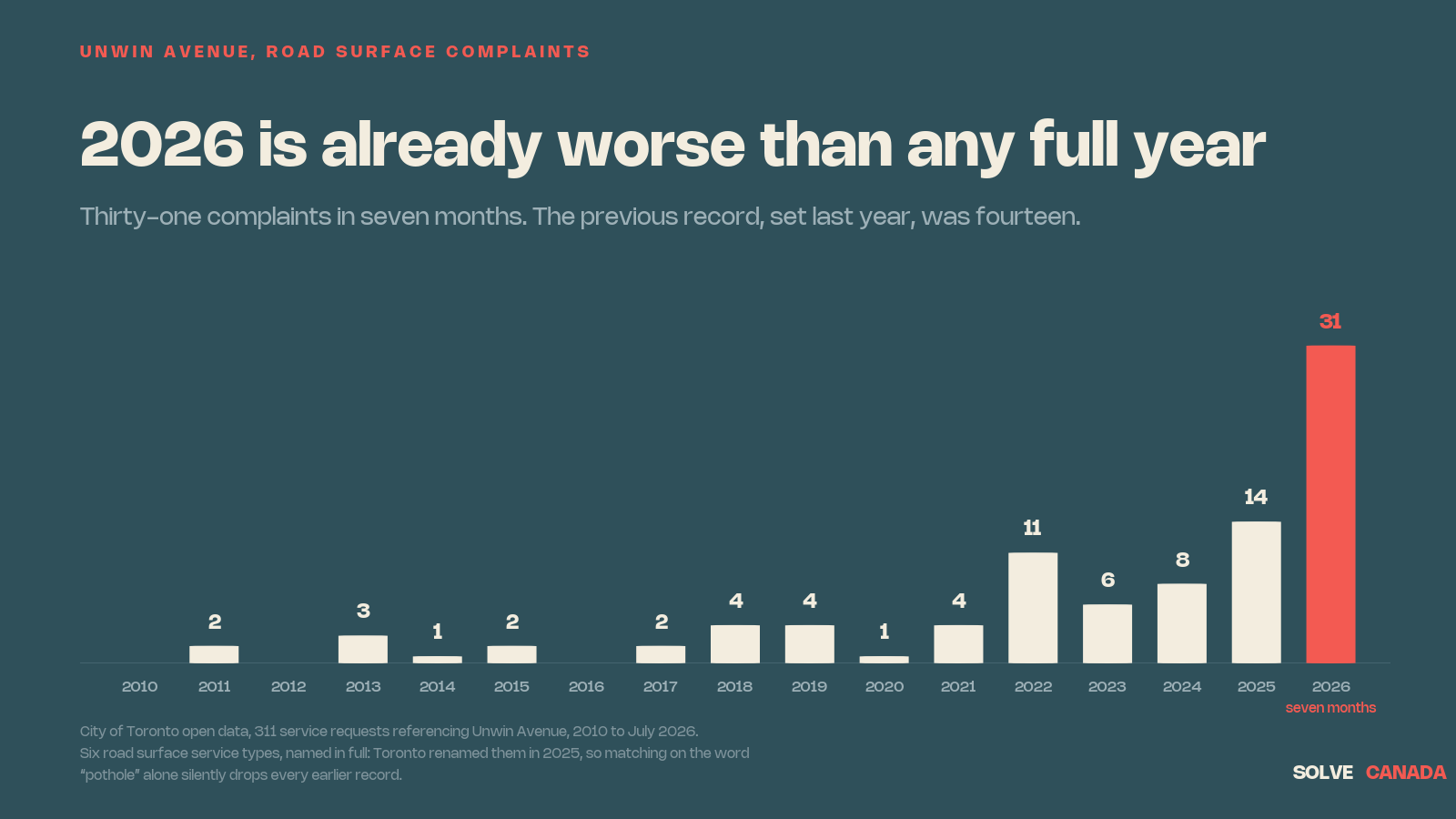
City of Toronto open data, 2010 to July 2026. Six road surface service types, named in full.
The road has been getting worse for years, and then this year it fell off a cliff. Thirty-one complaints in the first seven months of 2026. The previous record for a full year was fourteen, set last year, and before that eleven in 2022. Seven months of 2026 is more than double the worst full year on record.
They are also concentrated. Of the 180 total requests referencing Unwin, one hundred and seventeen sit at Regatta Road and Unwin Avenue, and another forty-two at the entrance to the Cherry Beach sports fields. That is 88% of them at two points. This is not a vague grumble about a corridor. It is two specific points that people hit, and report, over and over.
The number I keep coming back to
Of those 93 road surface complaints, sixty-seven are marked Completed and twenty-three are marked Closed.
That is 97%.
Ninety-seven per cent resolved, on a street where a television crew stood and watched passenger cars nearly get stuck, where a driver told them he thought he was going to lose his car.
The city is not lying
This is the part I want to be careful about, because the easy version of this post is wrong.
The City of Toronto told CityNews that “recent repairs, including pothole repairs, have been completed” while staff develop a plan for additional repairs this fall. The data agrees with them. Crews did go out. Tickets were opened, work was done, tickets were closed. Staff also gave a real explanation for why the road keeps failing: increased truck traffic, and a high water table that accelerates pothole formation. Both are true, and neither is anyone’s fault.
So nobody is fabricating anything. “Completed” is an accurate description of what happened to the service request.
It is just not a description of what happened to the road.
Completed is a ticket state
I wrote about this in June, when a resident’s report at 235 Queens Quay West was marked “Completed” the day after it was filed, with no inspection, no work scheduled, and a quiet redirect to a third party. That was one report. This is a street with fifteen years of them.
The mechanism is the same, and it is not malice. Toronto has been trying to close this loop since 2011, which is the same year the first road surface complaint about Unwin was filed. The problem is that the only thing measurable at the end of a service request is whether the request was closed. Nobody goes back to the person who filed it and asks whether anything actually changed. So a road can absorb thirty-one surface complaints in seven months, return a 97% completion rate, and still be a road that a dirt hauler crosses at four kilometres an hour.
Nobody designed it that way. It is what you get when the loop ends at the ticket instead of the street.
One thing I got wrong first
When I first ran this, I got 47 complaints, not 93, and a chart that showed a flat line for fifteen years and then a sudden cliff. It was a much more dramatic picture and it was wrong.
Toronto renamed the service type in 2025. Before then a pothole on Unwin was logged as Road - Pot hole. After, it is Road Pothole / Road Damage. Search for the word “pothole” and you silently lose every record before 2025, along with everything filed as Road - Damaged. Half the history disappears and the remaining half looks like an explosion out of nowhere.
I am including this because it is the kind of mistake that is invisible once it is in a chart, and because anyone checking my numbers should be able to reproduce them. The six service types counted here are Road Pothole / Road Damage, Road - Pot hole, Road - Damaged, Road - Sinking, Minor Road Damage and Bike Lane Pothole.
What would have to change
Not more reporting. Ninety-three complaints have already been filed about this one road surface, thirty-one of them since January. Reporting is not the bottleneck.
What is missing is the last step: the person who reported it being asked, afterwards, whether it is actually fixed, and that answer being worth as much as the closure code. That is what happens after you hit send on ours, and it is the only part of this that is hard to fake. Do that and “completed” stops being a self-assessment. A street where thirty-one people report the same surface in seven months stops looking like thirty-one resolved tickets and starts looking like what it is.
The part worth watching
In April the city said additional repairs were being planned for this fall. It is now late August. That is a specific, dated, checkable commitment, and the data that would show whether it worked is public.
I will come back to this in November and run the same query.
A note on the numbers. These come from the City of Toronto’s own published 311 data, not from ours. The address field in that dataset records intersections rather than street addresses, and only about a fifth of records carry one at all, so these are floors rather than counts: the true number of Unwin requests is higher. “Completed” and “Closed” are the city’s own status codes. Every figure here was checked against the files Toronto itself publishes, including the 2026 file it released on 8 August 2026, which runs to July 31. And for the avoidance of doubt, we have received zero reports about Unwin Avenue ourselves, which tells you something too.